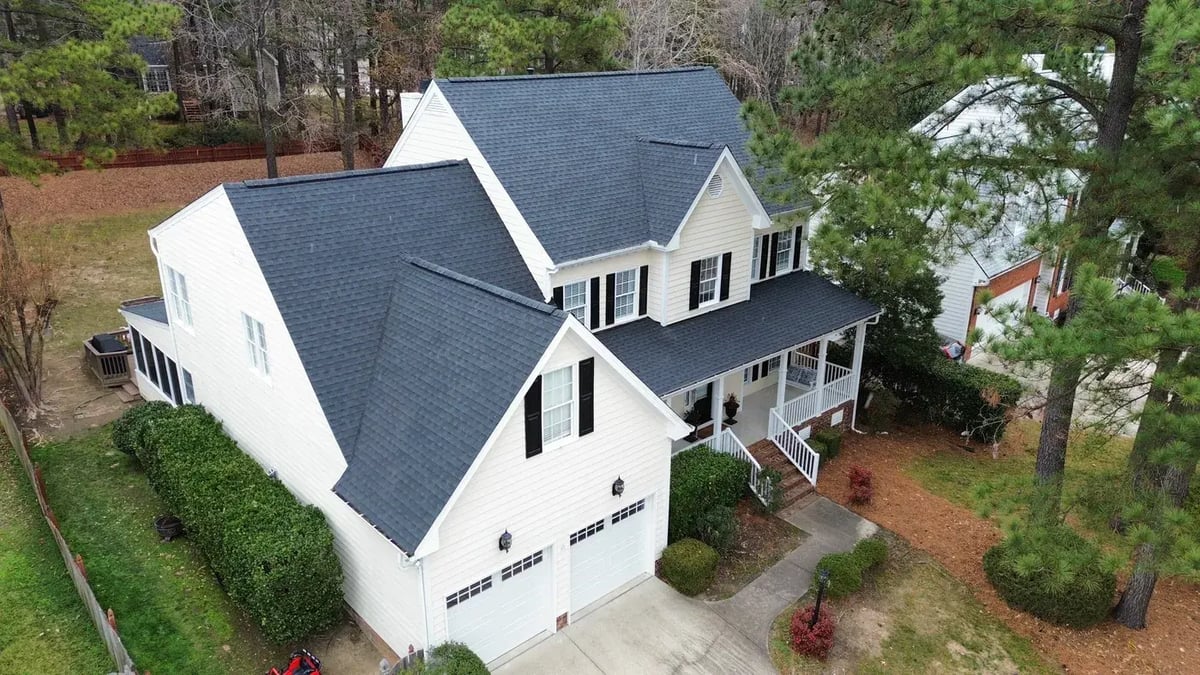
What drives the price of a new roof?
The two biggest factors in any roof replacement are the material you choose and the size of your roof. Both labor and materials are priced per square foot of roof area, not by how long the installation takes. If you were to rank every factor that affects cost, the choice between metal and asphalt would be number one, and the overall size of the roof would be number two. Everything else has a much smaller impact on the final number.
To put that in perspective, upgrading from standard architectural shingles to a premium line typically adds only a few hundred dollars on most homes. Adding another 200 square feet of roof area, on the other hand, can add $1,000 or more. Stories, pitch, skylights, and chimney flashing all play a role, but material choice and roof size are what set the baseline for your estimate.
Why is my roof bigger than my home?
Roofs are measured in square feet just like your home, but the two numbers will never match. Your home's listed square footage does not include the overhangs that extend past the exterior walls, covered porches, the garage, or any unfinished areas that still sit under the roofline. All of those areas need to be roofed, so they get added back in when we calculate roof size.
On top of that, we apply a slope factor because steeper roofs have more surface area than the footprint they cover. We also apply a waste factor because cutting shingles or metal panels to fit around valleys, hips, and edges is a normal part of every installation. Once you account for overhangs, slope, and waste, most roofs end up 15 to 25 percent larger than the home's listed square footage.
What does "squares" mean in roofing?
A "square" is an industry-standard unit that equals 100 square feet of roof area. If your roof measures 2,500 square feet, a contractor would describe it as a 25-square roof. The term exists because it gives everyone in the roofing industry a quick, consistent way to talk about roof size, estimate materials, and compare jobs without dealing with large numbers. You will see this unit on most roofing proposals and material orders.
Why didn't the calculator ask about shingle brands or product lines?
The vast majority of roof replacements in North Carolina are done with architectural asphalt shingles. There are five major manufacturers in the market, and we sell products from several of them. Each manufacturer offers an entry-level line designed for new construction and apartments, a standard line that covers almost all residential replacements, and a premium line that adds upgraded aesthetics and slightly better performance for roughly 10 percent more.
This calculator is priced around standard architectural shingles such as GAF Timberline HDZ, CertainTeed Landmark, and Owens Corning Duration. Those are the most commonly installed products and the best fit for the majority of homeowners. In parts of Central North Carolina where three-tab shingles are still common, such as the Fayetteville area, actual prices tend to run about 10 to 15 percent lower than what this calculator shows.
Why does the calculator show a price range instead of an exact number?
The specific layout and design of your home have a significant impact on the final cost of a roof replacement. During an on-site inspection, we measure the overall roof area but also count every eave, rake, valley, hip, ridge, and penetration individually. Those measurements allow us to accurately price underlayment, ice and water shield, step flashing lengths, drip edge, and every other material that goes into the job.
By the time we give you an actual written estimate, we have already built a complete material list for your specific roof and know exactly what labor and materials the job requires. A basic online calculator cannot account for that level of detail, so showing a range gives you a realistic expectation without overpromising precision that only comes from real measurements.
Why does the calculator price skylights as full replacements?
We recommend replacing skylights during a roof replacement rather than simply reflashing them. Unless your existing skylights are in near-new condition, reflashing alone is usually not the best long-term outcome for the homeowner. Most skylights do not last 30 or more years, so if your roof has reached the end of its lifespan, your skylights are very likely approaching the end of theirs as well.
Skylight repairs on their own are also quite expensive. It is not uncommon for a single skylight repair in North Carolina to cost over $2,500 when done as a standalone job. Replacing skylights while the roof is already open is less expensive overall and allows the crew to properly flash and integrate the new units from the start, which reduces the chance of future leaks.
Why do you offer financing for roof replacements?
Most homeowners are not planning on a new roof until they discover a leak or their inspector flags a problem. We understand it is a significant, often unexpected expense, and we want to make it as accessible as possible. It is worth noting that we do not earn money from our financing programs. They actually cost us to operate, and we make less on financed jobs than on jobs paid in full. We offer them because they genuinely help our customers move forward with a roof they need.
Financing has become popular with our customers. We offer a 12-month option for homeowners who want to pay the balance off quickly and a 120-month option for those who need a lower monthly payment. Both options are available through Service Finance Company, and you can get pre-qualified before your on-site inspection so you know your monthly payment before making any decisions.
How accurate is this online pricing calculator?
We developed this calculator in-house using real pricing data from jobs we have completed in the Triangle area of North Carolina. Before making it available, we tested the output against recently completed projects to verify that the estimates it produces reflect what homeowners are actually paying. For the majority of homes in the Raleigh, Durham, and surrounding areas, it is quite accurate.
That said, roofing prices are not static. Material manufacturers issue price increases at various points throughout the year, fuel costs fluctuate, and labor availability changes with market conditions. We have made a best effort to keep the calculator current, but your actual price could differ based on timing or specific details about your home that a basic calculator cannot capture. This tool gives you a well-informed starting point, and the free on-site inspection is what gives you the real number.